Process application

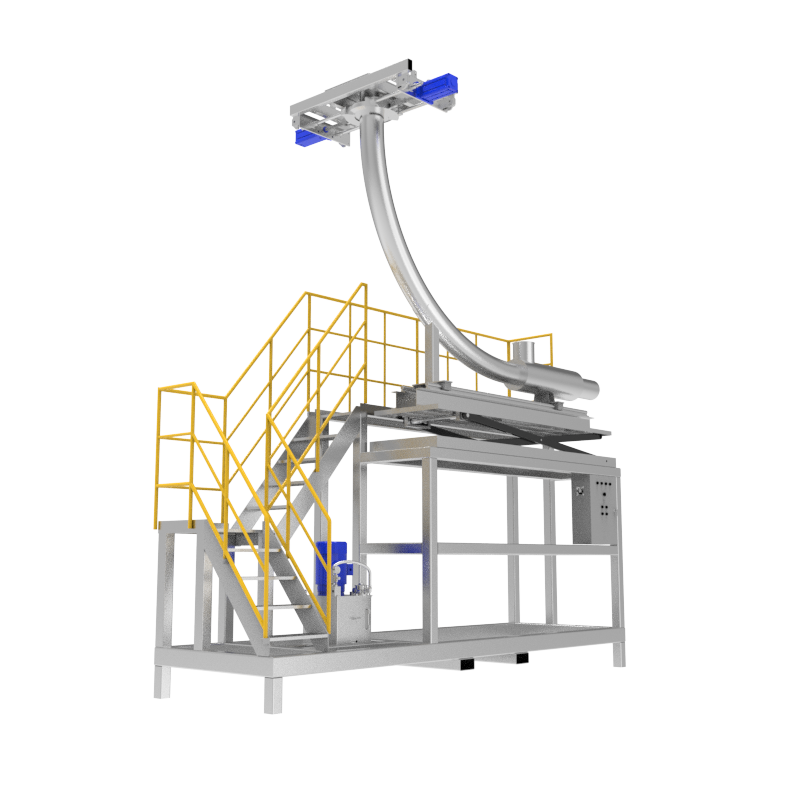
Container Rear Loading System

Improving the loading efficiency of powder and granular materials

Meeting the demand for rapid, accurate, and safe bulk loading for medium or long haul and ocean transportation.

Container Rear Loading System

Product Characteristics

Efficient Loading

Rapidly completes high-quality loading of powders and granular materials, shortens vehicle waiting time, and enhances logistics turnover efficiency.

Dust-Free Operation

Utilizes sealing and dust removal technologies to achieve zero dust emission, reduces material loss, and meets environmental requirements.

Stability

Optimized mechanical structure and automated control prevent bag rupture risks caused by material impact or unstable flow rates.

Automated Management

Logistics data is automatically recorded and processed, requiring only 1 operator for automated loading.

Technical Parameters

NameParameters
Equipment NameContainer Rear Loading System
Loading Speed30~120t/h
Metering Accuracy±0.3%FS (full scale)
Material Inlet SizeΦ150/Φ200

Maintenance and Services

of Container Rear Loading System

Cannot find the solution you are looking for? Please visit our Q&A Center for answers, or contact us for further help and support.
Q Working Principles of the Container Rear Loading System
The core principle is "Material Conveyance, Precise Distribution, and Intelligent Speed Control". Material from the upstream storage silo is conveyed via a belt conveyor/screw conveyor to a telescopic chute, which extends into the container and retracts synchronously with the loading progress. Level sensors monitor the fill height in real-time, automatically adjusting the chute height and material feed rate to prevent uneven loading. Some systems are equipped with distribution devices to ensure uniform filling. The entire process utilizes negative pressure dust extraction to minimize dust emission.
Q Can the container rear loading system be customized?
The equipment offers strong adaptability and can be customized as needed. The container specifications (20'/40'/special containers) determine the chute length, telescopic travel, and loading platform height. Material characteristics (powder/granules/small lumps) determine the selection of conveying equipment (belt/conveyor/air conveyor) and chute material (stainless steel/wear-resistant lining). The capacity (50-500t/h) is matched with the power of the conveying module. For space-constrained sites, a foldable chute design is available, and specific requirements can be met by adding features such as metal detection and blockage alarm functions.
Q Maintenance of the Equipment
Daily Maintenance: Before shift, check the telescopic flexibility of the chute, the tension of the conveyor belt, and the cleanliness of the dust filter screen; after shift, clean residual material from the equipment and shut off power and air supply. Regular Maintenance: Weekly, lubricate the chute guides and conveyor rollers; monthly, calibrate level sensors and inspect conveyor belt wear; quarterly, test dust removal fan performance and tighten all connection bolts to prevent vibration caused by loosening.
Q Precautions
Before loading, confirm the container is securely fixed and the chute is accurately aligned with the container to prevent misalignment and material leakage.
During equipment operation, personnel are prohibited from approaching the telescopic chute and conveyor belt. Maintenance must follow a lockout-tagout procedure.
For damp materials, perform pretreatment to prevent agglomeration and chute blockage. After operation, thoroughly clean the equipment. Outdoor systems require protection against rain and freezing.

Expert Consultation Portal

Assisting you in formulating industrial upgrade plans

Reservation

Demonstration

Consultation
Customer Service