Process application

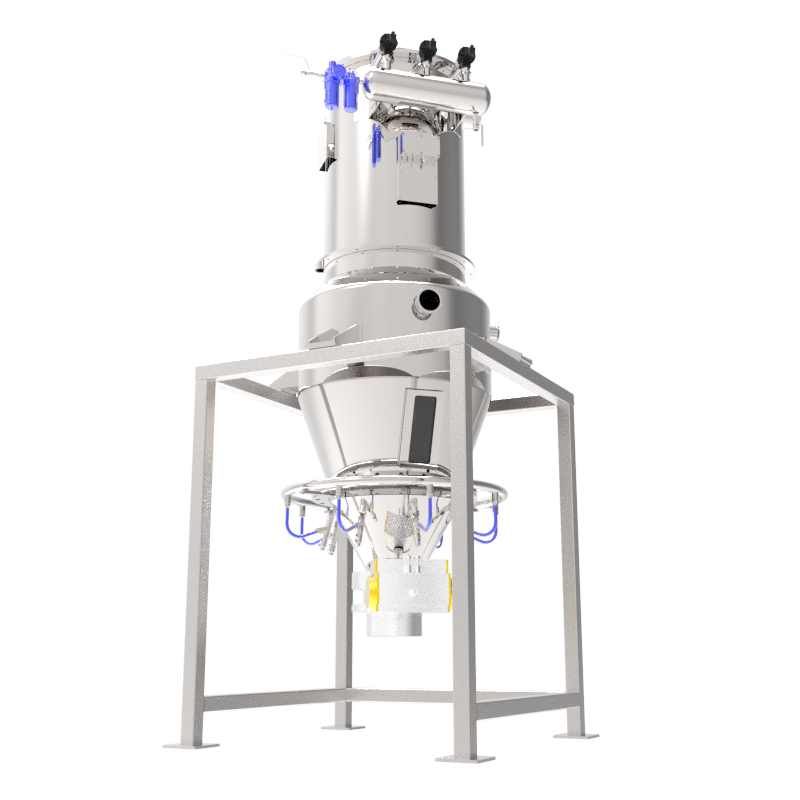
Airflow Mixer

Improving the efficiency of material mixing

Achieving thorough material mixing through the action of airflow.

Airflow Mixer

Product Characteristics

Integrated Functions

The equipment integrates three major functions of vacuum conveyance, dynamic mixing, and clean emission to reduce material transfer, effectively reducing the risk of cross-contamination by 40%.

High-Efficiency Mixing

Adjustable pulse frequency shortens mixing cycle to 2-60 min/batch; The total silo volume is 0.3m³-150m³, with volume efficiency reaching 20-65%.

Uniform Mixing

CFD is used to optimize the three-dimensional flow field, so that materials can be fully blended in the complex and orderly airflow, achieving highly uniform mixing to ensure stable product quality.

Material Protection

Drive mixing with airflow instead of mechanical stirring mode, which effectively protects heat-sensitive and vulnerable materials, thus broadening the range of applicable materials for the equipment.

Convenient Maintenance

Modular quick-release design with Mean Time To Repair (MTTR) less than 60 minutes, reducing downtime and maintenance costs.

Technical Parameters

NameParameters
Equipment NameAirflow mixer
Dust Collection Fan300L~150m³
Vibrating Fan20 ~ 65%
Gas Supply Pressure0.4 ~ 1.3 MPa

Maintenance and Services

of Airflow Mixer
Cannot find the solution you are looking for? Please visit our Q&A Center for answers, or contact us for further help and support.
Q Working Principles of the Airflow Mixer
The core principle is "airflow disturbance + three-dimensional mixing." Compressed air forms a high-speed airflow through special nozzles, impacting and carrying materials to suspend them in the mixing chamber. The airflow drives materials in irregular motion, while internal guide structures direct materials to create circulatory convection, achieving rapid interpenetration and diffusion of different components for uniform mixing in a short time. After mixing, the material is discharged through the discharge valve.
Q Can the airflow mixer be customized?
This equipment can be precisely configured as needed. Material characteristics (particle size/density/flowability) determine the nozzle type and airflow pressure; mixing precision (±0.1% - ±1%) dictates the guide structure and mixing time; production capacity (0.1-50m³/batch) matches the chamber volume. For special requirements, options include explosion-proof motors, vacuum systems (to prevent oxidation), spraying devices (for liquid-solid mixing), making it suitable for industries such as pharmaceuticals, food, and chemicals.
Q Maintenance of the Airflow Mixer
Daily Maintenance: Before shift, check air path sealing, nozzle clearances, and discharge valve flexibility; after shift, clean residual material from the mixing chamber and shut off air and power supplies. Regular Maintenance: Weekly, clean nozzle deposits and inspect filter screen integrity; monthly, lubricate transmission components and replace aged sealing rings; quarterly, calibrate airflow pressure gauges to ensure consistent mixing efficiency.
Q Precautions
Before starting, confirm the chamber is free of foreign objects and the air path is unobstructed; perform a no-load test run to check airflow stability. Strictly prohibit mixing excessively hard impurities or metal blocks to prevent nozzle damage. For flammable or explosive materials, use explosion-proof models and ensure proper grounding. For viscous materials, control moisture content and clean promptly after mixing to prevent agglomeration. Before maintenance, depressurize and disconnect power to avoid injury from air jetting.

Expert Consultation Portal

Assisting you in formulating industrial upgrade plans

Reservation

Demonstration

Consultation
Customer Service