Process application

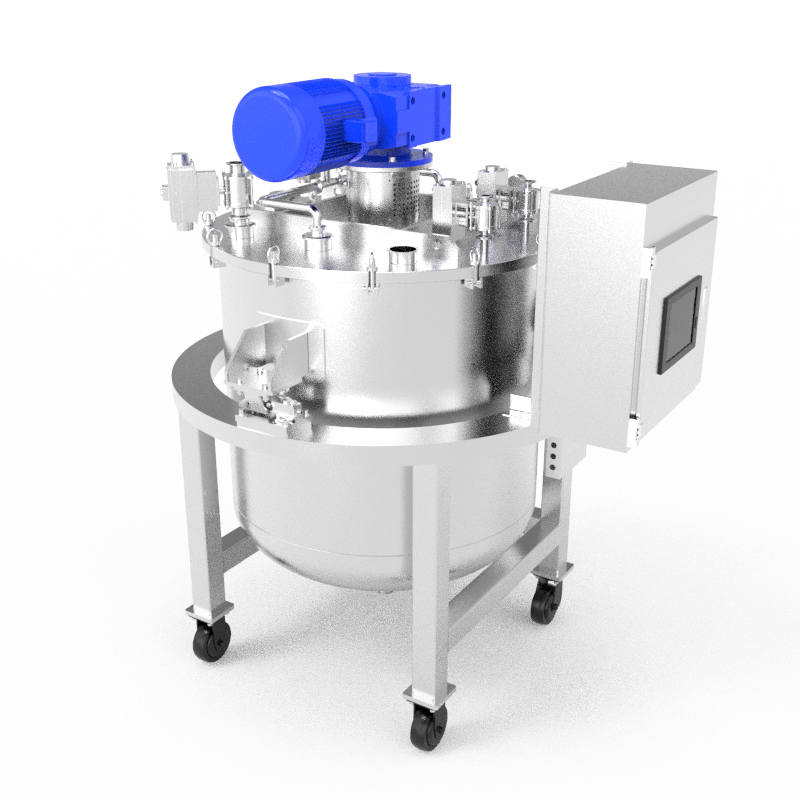
Mixing Tank/ Transfer Tank

Improving the efficiency of material mixing

Achieving macroscopic homogenization of materials through the rotation of agitation blades.

Mixing Tank/ Transfer Tank

Product Characteristics

Efficient Mixing

Combination of frame + ribbon (hybrid) blades achieves full-tank convective mixing.

Temperature Control

304 stainless steel jacket/coil supports broad-range temperature control from -20°C to 230°C.

Vacuum Defoaming

Vacuum pump set is optional and suitable for degassing high-purity materials.

Intelligent Cleaning

CIP online cleaning + SIP sterilization (optional) with cleaning coverage ≥95%.

Convenient Operation

The standard button box is ready to use immediately upon startup. An optional PLC touch screen is available for one-click invocation and traceability of production data, lowering manual operation.

Safety Protection

Overload protection, overpressure relief valve and explosion-proof components ensure the safety of operations in flammable and explosive environments.

Technical Parameters

NameParameters
Equipment NameMixing tank
Specification of the Material InletΦ38.1~Φ50.8
Specification of the Material OutletΦ50.8~Φ89
Effective Volume of the Tank100~2000L
Supporting MethodSupporting Lug/ Supporting Leg/ Trolley

Maintenance and Services

of the Mixing Tank/ Transfer Tank
Cannot find the solution you are looking for? Please visit our Q&A Center for answers, or contact us for further help and support.
Q Working Principles of the Mixing Tank/ Transfer Tank
The core function of a mixing tank is to achieve material mixing, homogenization, heat transfer, or suspension through mechanical agitation. Its basic working principle is as follows: The drive unit (typically an electric motor and gear reducer) provides power to rotate the mixing shaft and the impellers mounted on it inside the tank. During rotation, the impellers generate shear and circulation forces on the liquid in the tank, rapidly agitating and intermixing materials of different components, densities, or temperatures, ultimately achieving a uniform state that meets process requirements. In contrast, a transfer tank focuses more on temporary storage and buffering, where agitation is primarily used to prevent material sedimentation and stratification, maintaining uniformity, and its structure is relatively simpler. The entire process typically takes place in a sealed vessel and can be equipped with heating, cooling, vacuum, or pressurization functions as needed.
Q Can the mixing tank/ transfer tank be customized?
The customization of a mixing tank requires determining key parameters based on specific process needs. These primarily include:
Material: Selected according to material corrosiveness and cleanliness requirements, such as SUS304/316L stainless steel, carbon steel, or special alloys.
Volume and Structure: Determining nominal volume, aspect ratio, head type, and designing attachments such as jackets (for temperature control), coils, manholes, sight glasses, etc.
Agitation Type: Based on material viscosity and mixing objectives, selecting different blades such as anchor, paddle, turbine, or propeller types, and determining the speed range (fixed or variable frequency drive).
Sealing Method: Commonly using packing seals or mechanical seals. For hazardous, valuable, or sterile environment requirements, reliable mechanical seals must be selected.
Surface Treatment: The interior wall can be polished (e.g., mirror finish, mechanical blasting), and the exterior surface can be sandblasted, painted, or polished to meet hygiene or aesthetic standards in different industries.
Q Maintenance of the Mixing Tank/ Transfer Tank
Good maintenance is key to ensuring long equipment life and stable operation.
Daily Maintenance: After each use, thoroughly clean the equipment promptly to prevent material residue, cross-contamination, or corrosion. Check and tighten bolts at all connection points.
Regular Inspection: Periodically (e.g., quarterly or semi-annually) check the lubricant level and quality of the reducer lubricant, and replenish or replace as needed. Inspect the wear condition of the mechanical seal; if leakage occurs, address or replace it immediately. Calibrate instruments such as thermometers and pressure gauges.
Long-Term Shutdown: If the equipment will be idle for an extended period, drain all materials and water from the tank and jacket, clean and dry thoroughly, and seal all openings with blind plates to prevent dust and moisture ingress.
Q Precautions
When operating a mixing tank, safety is the top priority.
Pre-Operation Checks: Before starting, ensure the tank is free of foreign objects, the impeller rotates without obstruction, all sealing points are intact, and all inlet/outlet valves are in the correct positions.
No Dry Running or Overloading: The mixing shaft must be submerged in liquid before startup. Dry running is strictly prohibited to avoid damaging the mechanical seal and mixing components. Operating beyond specified temperature, pressure, or load limits is also strictly forbidden.
Safe Operation: While the equipment is running, never insert hands or any tools into the tank. If entry is required for maintenance, power must be disconnected, warning signs posted, and adequate ventilation ensured with harmful gases fully purged.
Abnormal Situation Handling: If unusual noise, vibration, or leakage occurs during operation, stop the machine immediately for inspection. Do not resume use until the issue is resolved.

Expert Consultation Portal

Assisting you in formulating industrial upgrade plans

Reservation

Demonstration

Consultation
Customer Service